
This article was originally published in the April 2015 issue of Australian Family Tree Connections magazine, where it was a prize winner.
The story could not have been written without the generosity of family. Coral Ellement kindly shared her transcriptions of the postcards Victor sent home from the war, and Ken Andersen provided copies of the postcards themselves. Their willingness to share these precious family keepsakes brought Victor’s voice to life, and I am grateful to them both.
Charles Joseph Ellement and Mary Ann Combridge were both born in Victoria and married there. Their 10 children were born in Geelong before the family moved to Western Australia around 1901–02
Their children either travelled with them or followed within a couple of years:
- Martha Eva born 1880
- Frederick Charles born 1882
- William Benjamin George born 1884
- Lilian Annie born 1886
- Robert Harold Baker born 1888
- Victor Ernest born 1890
- Amy Myrtle born 1892
- Herbert Arthur born 1893
- John Roy born 1897
- Mabel Clare born 1900
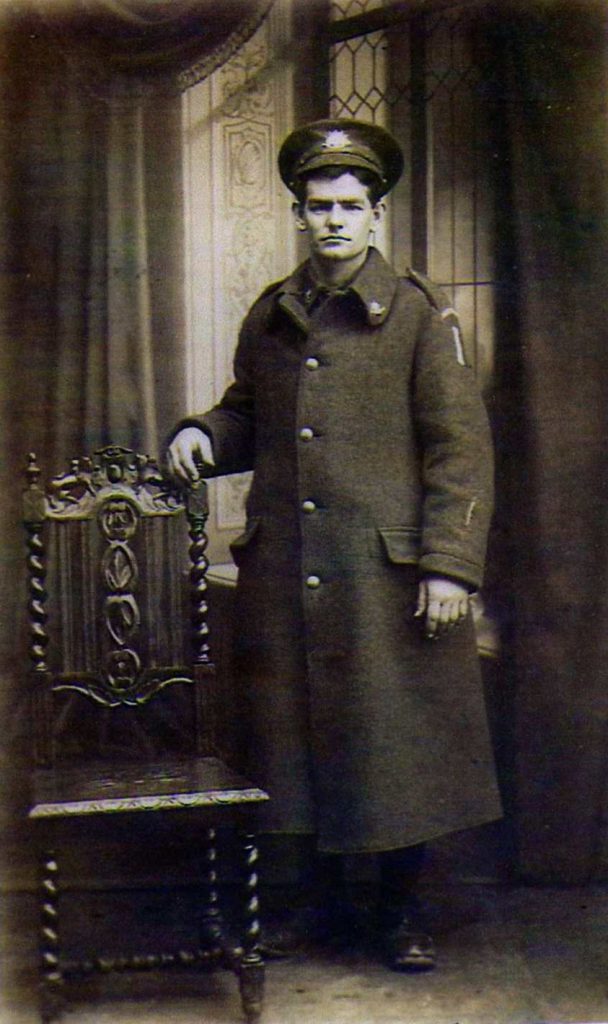
They all lived around the Cockburn area and many had market gardens
World War One broke out in 1914 and on 3 May 1915 the government advised that land would be resumed in the Cockburn area for a proposed Naval Base. For the Ellement family this meant the majority of them were about to lose the land that they had lived and worked on since the early 1900s.
Matthew Love, husband of their eldest daughter Martha, was a poultry farmer and received notification that his land was part of the land resumption. Eldest son Frederick also received notice that his land was part of the land resumption and then the Ellement Bros (Robert, Victor, Herbert and John Roy, the four youngest sons) received notification that their land was part of the land resumption. They were all market gardeners. Compensation was paid, however that would not have taken away the feelings of loss, not just their land but also their livelihoods. In Victor’s case, he was away at war while this was occurring back at home. While we have no idea how he felt about it, it seems ironic that while he was serving his country, his country was taking his land.
Second son Frederick was working as the groundsman at the Seaview Golf Club (called the Cottesloe Golf Club at the time). Due to the numbers of men away at war, the club’s membership dropped substantially and Fred’s hours were halved. Fred had a wife and 11 children, seven of whom were born prior to 1915. Having so many mouths to feed on half wages became even more difficult as he was affected by the resumption of the land on which he grew produce to help feed his family.
Fifth son Herbert (known as Bert) was aged 21 years 8 months when he enlisted in the Australian Imperial Force on 29 June 1915 and was part of the 28th Battalion that went to Gallipoli. On 14 October 1915 he received a severe gunshot wound to the head and was admitted to the 15th General Hospital Alexandria. Once he’d made some substantial improvement he was transported to England. While recovering in hospital he met a nurse, Louise Hibberd, whom he later married. Bert was on a pension for several years while recovering from his injuries. According to the book Cockburn, The Making of a Community by Michael Berson, Ellement Parade in Coogee was named after Herbert.
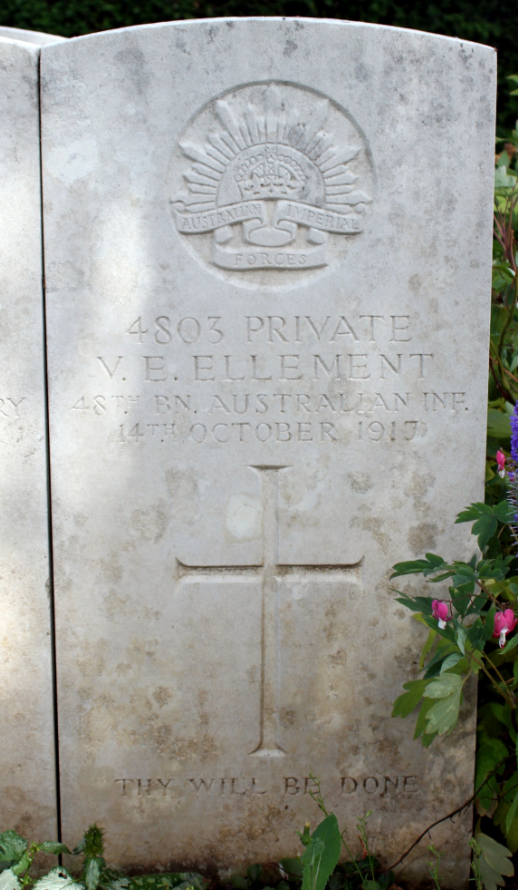
Fourth son Victor enlisted in the Australian Imperial Force on 29 November 1915, six weeks after his brother had been severely injured. He was 23 years 3 months of age. Victor was part of the 48th Battalion. On 14 September 1916 he received a gun shot wound to the foot which was listed as mild. There is also a note in his service record that he was suffering from slight shell shock. He later re-joined his battalion in France. On 12 October 1917 he received a gunshot wound to his thigh and he died two days later from his wounds. He is buried in Bois Guillaume Communal Cemetery, France. The 14th of October was an unlucky day.
Victor appears to have regularly written postcards to family at home during the war, of which the words from three of them are below:
Dear Beeb, This is the hospital I got sent to when I got wounded in France. I am leaving here for London any day, give my love to your little man, tell him I’ll be back to have some of his mum’s custard some day. I only have sore eyes but am feeling well now. Love from Vic.
Have had no mail from Aust since Aug 18 will get my letters when I go back to batt.
(Beeb was Victor’s sister Martha’s nickname and this postcard was obviously written after September 1916 when he was wounded in the foot in France.)
The date of the next postcard is unknown:
Dear Matt & Beeb,
Just a few lines hope this card finds yous all well as it leaves me at present, was not feeling to good when this was taken but am much better now. Give my love to your little man, I suppose your land trouble is all fixed up now. Weather here is very rough at present. I expect your weather is fine, don’t know how I will get on in the trenches Xmas time in France.
Your Old Pal
Pea Wee.
(Pea Wee was Victor’s nickname).
On another letter postcard he sent home (again undated and it isn’t known who it was addressed to), Victor had written:
In the letter is a violet which Bill sent me with some wattle blossom, give it to Beeb to remember me. It has been to Egypt, France, England, Wales, back to England and now I am sending it back to Australia. It has been a long way.
(Bill was William, one of Victor’s older brothers.)
It appears the violet made it home but unfortunately Victor didn’t. He was injured again during combat in Passchendale, Belgium when he received the gunshot wound to the thigh. He was taken to hospital in Rouen, France but died from his injuries.
Last week Mr. Chas. Ellement, of Fremantle, received a cable stating that his fourth son, Victor, had been killed in action on October 14, 1917. He was wounded in the Pozieres battle on August 14, but returned to France in early January. By a curious coincidence his brother Bert was severely wounded at Gallipoli on October 14, 1914. Victor will be greatly missed by a large circle of friends, among whom he was popularly known as “Smiling Peewee.” A cousin of these boys, Lce.-Cpl. E. Harris was also killed in action this year. The great-grandfather of these brave lads was also killed in action in the Franco-Prussian War. Worthy sons of a Worthy sire.
Sunday Times (Perth WA) Sunday 11 November 1917, page 14
The family is aware that the boys’ grandfather, George Griffiths, was an officer in the army in England, however no record of his service in the Franco-Prussian War has yet been found.
The Ellement family was just one of many that were affected in a variety of ways by WWI. For some it was the loss of land, for others unemployment. There were injuries and the biggest loss of all was life. Some families suffered more than one loss. Some bought more land and started new market gardens, some survived injuries. Parents and siblings grieved but had to move forward with their lives and so they did.
Herbert, who was badly injured, is on the Hamilton Hill War Memorial in a list of ‘The Brave’. Victor is remembered on the Hamilton Hill Memorial, Western Australia in a list of ‘The Heroic Dead, Their Name Liveth For Evermore.’
Sources
National Archives file P3366/123, Compulsory acquisition of site for Defence land at Henderson Naval Base, Cockburn Sound WA, Claim of Matthew Love
National Archives file P3366/257, Compulsory acquisition of sire for Defence land at Cockburn Sound WA, claim of Frederick Charles Ellement
National Archives file P3366/256, Compulsory acquisition of site for Defence land at Cockburn Sound WA, claim of Ellement Brothers
National Archives file Series B2455 Ellement HA
National Archives file Series B2455 Ellement VE
National Archives file Series PP13/1 Ellement Victor Ernest
Berson, Michael, Cockburn, The Making of a Community, Town of Cockburn, 1978
McEachran, Graham and Ryan, Phil McEachran Cottesloe Golf Club: a centenary history 1908–2008, Seaborne WA, 2010
Sunday Times, 28 November 1951, page 1
Coral Ellement (postcard transcriptions of postcards originally sent by Victor Ellement)
Ken Andersen (copies of postcards originally sent by Victor Ellement)
Find A Grave, headstone of Victor Ellement at Bois- Guillaume Communal Cemetery, Rouen , France