
Bringing ancestral stories to life through expert family history research. This feature article—originally published in the September 2015 edition of Western Ancestor—explores the compelling story of an early Australian “exile”, illustrating the level of historical detail, deep archival investigation, and narrative storytelling I bring to every client project.
An Exile Or A Convict?
By Judy Purkiss, 2015
JOB KING ELLEMENT, my great-great-grandfather, was an intriguing character from the beginning. Firstly, he had an unusual name, and secondly, it appeared, he was convicted and transported for larceny (theft) to the colony of Victoria, in Australia. While that was interesting in itself, Victoria wasn’t a penal colony so how come he was transported there? It was definitely time to investigate my ancestor further; here’s what I found.
Job was baptised on the 4th November 1821 at St Mary’s, Chesham, Buckinghamshire, England¹. His name on the baptismal record is Job King Element². It appears that in England his name was spelt with one ‘l’, whereas most records (although not all) in Australia had a double ‘l’. Job’s parents were John Element³ and Ann King⁴. This explained Job’s middle name. Job had a younger brother called Thomas Brown Element and 4 half siblings from his father’s previous marriage, they were; Joseph, Phillis, Elizabeth and Susannah.
Job’s first marriage was to Rebecca Taylor on the 8th June 1842 at Aylesbury, Buckinghamshire, England [1]. His occupation is listed as a labourer [2]. Job and Rebecca had three children, James b1839, Ann b1840 and Elizabeth b1843, and all were baptised at Chesham. James and Ann were born prior to the marriage; however Rebecca still called herself Element on their birth records. They lived next door to Job’s parents at Hearns Yard, Chesham (now known as Bury Lane). The cottages in Hearns Yard were known as the Sixpenny Cottages, so named because their rent was 6d a week. Basically, this was a poor area.
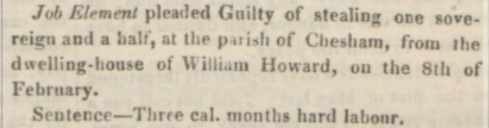
Job was charged with larceny for the crime of stealing a tin box and a sovereign and a half from the dwelling house of William Howard on the 8th February 1842 [3][4]. He was sentenced to three calendar months of hard labour. There are two things that may have put extra pressure on the family’s finances at this time. Job’s wife, Rebecca, may have been sick and his father John died of chronic bronchitis on the 23rd April 1844 [5]. As his mother lived next door, Job may have needed to financially assist her household.
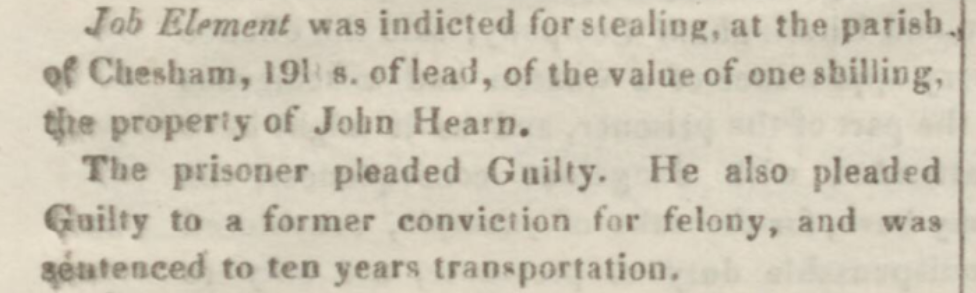
On the 29th November 1844, Thomas (Job’s brother) was charged with stealing two shirts and one handkerchief and Ann (Job’s mother) was charged with receiving them [3,6]. Both were fortunately acquitted. Not long after, on the 31st December 1844, Job was charged with stealing lead inlay. As it was a second offence for Job, the sentence was much stiffer, and in January 1845 he was sentenced to 10 years transportation [3,7]. Job’s sick wife and three children were now without his income, as was his mother.
I can only wonder what Job felt about the predicament his family was in at this stage, however, events were to further conspire against him. Job’s wife Rebecca died of phthisis (archaic name for tuberculosis) on the 20th June 1846 [8]. The 1861 UK census shows Ann Element was now looking after Job’s three children, plus John J Element a grandson (the son of Elizabeth, Job’s youngest daughter) [9]. Job went from Aylesbury prison, to Pentonville and then to Millbank. When he was received at Pentonville he was described as weighing 10 stone 3lbs, his character was ‘good’ and he could read and write. While in prison he learnt the trade of rugmaking.
Job Ellement boarded the Thomas Arbuthnot in January 1847 [10], to be transported to Victoria. The colony of Victoria was short of labour, however, they didn’t want to be labelled a ‘penal colony’ so it was decided that a certain number of prisoners (known as exiles) would be sent under special conditions. The prisoners selected were to have completed 15 to 24 months of their sentences in England and they were given a conditional pardon when they arrived [11]. They were free men, provided they did not return to England until the terms of their original sentence expired. Approximately, 1,750 ‘exiles’ came to Australia. Newspapers of the time often referred to them as Pentonvillians as many came from Pentonville Jail.
Job landed at Port Phillip Bay in early May 1847 and started a new life. On the ‘disposal list’ for the ship, Job is shown as being engaged to work as a shepherd in the Grampians by a Mr W Shepherd(?) for a period of one year at a rate of 20 pounds. The next we hear of Job is on the 11th January 1853 when his name appears in the Geelong Advertiser as having sold 82ozs of gold at Ballarat [12]. While we don’t know what he purchased with the gold, his name appears in the Geelong rate books from 1857, so perhaps he used the gold to purchase property [13].
A few weeks after selling the gold, on the 31st of January 1853, Job King Ellement married Margaret Fearon at the Christ Church in Geelong [14]. Not much is known about Margaret and what we do know is from a passenger list only. As Job was considered a free man upon landing in Victoria it appears he did not have to apply for permission to marry, which from a research point of view was unfortunate. We think she may be the Margaret Fearon who immigrated to Australia in September 1852 on board the Bournuef [15]. She is listed as a domestic servant for a Mr Robertson of the Union Bank. The passenger list also states she was from Ireland.
If this is ‘our Margaret Fearon’ then they married within four months of her arrival. The marriage was also short as, tragically, Margaret died less than three months later, on the 20th March 1853. She was buried on the 21st March 1853 at Geelong Eastern Cemetery [16]. Unfortunately, her cause of death is unknown. There is a family story that Margaret and Job had a child named Isaac, however, no record of him can be found. Given Margaret was only in Australia for six months and only married for three of those, it appears unlikely she had a child or if she did, then the child cannot be Job’s.
Within months Job marries again, this time to Elizabeth Jersey Griffiths on the 24th June 1853, again at the Christ Church in Geelong [17]. Eliza was from Jersey in the Channel Islands , and she was the fifth of six children born to George Griffiths and Mary Ann Green [19,20]. However, she was the first born in Jersey, hence her middle name. Eliza immigrated to Australia on the Runnymede in June 1852 [18]. Her passage was paid for by a Mr Robertson of Portland, and she was to work as a domestic servant for him. Could this be the same Mr Robertson that Margaret Fearon worked for? Quite likely, I’d say.
Job and Eliza had six children and all were born in Victoria. They were Henry b1854, Amelia b1856, Charles Joseph b1858, Edwin George b1861, Augustus Job b1865 and Eliza Annie b1866 [21,22]. Job’s mother Ann had died in England in 1863, aged 83 years [23]. Then his baby son Augustus Job died in 1865 in Australia, and his daughter Elizabeth from his first marriage died, in 1866, in England [21,23]. When Augustus Job died, aged of 11 months, the family were unable to afford to bury him and sought help in this matter. It was stated at the time, on a police report, that Job was in the country looking for work and Eliza was ‘taking in washing’ [25].
When Job’s daughter Elizabeth died in England, her son John had to go to the Amersham Workhouse [26]. Unfortunately, Job was not in a position to help him as he and his Australian family were struggling. Sadly, Job’s wife Elizabeth died in 1876, followed some years later by their son Edwin in 1883 [19,24]. However, Job still had many descendants; he had 35 (known) grandchildren of which ten were offspring of his English children and 25 were offspring of his Australian children. Many of these also had large families. While there are some Ellements still in Victoria, the vast majority live in Western Australia.
There is a rather sad article reported in the Geelong Advertiser on the 30th May 1890, called ‘A Queer Witness’ [28]. It states that Job Ellement was assaulted by his son Charles (who would have been 32 years old at the time). But when the case went to court Job Ellement wasn’t very co-operative in the witness stand. Given that he’d been to court himself and transported to Australia, it would make sense that he didn’t want to proceed with charges against his son. Job died eight years later on the 7th December 1898 in Geelong, Victoria [27]. His cause of death is hard to decipher on the death certificate, but it appears he died from a heart related illness.
Given the deaths in his family and hard times he endured during his life, I’m surprised he didn’t die of a broken heart. Three wives, three children and three grandchildren had died before him. Job King Ellement was buried in the Geelong Western Public Cemetery in an adjoining plot to his third wife Elizabeth Jersey Ellement. There is no headstone for either. His death notice in the Geelong Advertiser, on the 10th December 1898, simply states he was a colonist of 50 years [29]. So, I wonder, did his Australian family know he was an exile? Perhaps not!
Sources:
- Baptismal record for Job King Element at St Mary Chesham, Buckinghamshire.
- Marriage record of Job Element and Rebecca Taylor, Aylesbury, Buckinghamshire.
- England and Wales Criminal Records, Buckinghamshire.
- The Bucks Herald, 12 Mar 1842.
- Death certificate for John Element, Chesham, Buckinghamshire.
- The Bucks Herald, 7 Dec 1844.
- The Bucks Herald, 25 Jan 1845.
- Death Certificate for Rebecca Element nee Taylor, Chesham, Buckinghamshire.
- 1861 UK Census.
- Passenger list for Thomas Arbuthnot.
- http://prov.vic.gov.au/provguide-57
- Geelong Advertiser, 11 Jan 1853.
- Geelong Rates Books.
- Marriage record for Job Ellement and Margaret Fearon, Christ Church, Geelong.
- Passenger list for Bournef.
- Burial record for Margaret Ellement, Christ Church, Geelong.
- Marriage record for Job Ellement and Eliza Griffiths, Christ Church, Geelong.
- Passenger list for Runnymede.
- Death certificate for Eliza Jersey Ellement nee Griffiths.
- Military record of George Griffiths.
- Birth index records on Ancestry.com for Henry Ellement, Amelia Ellement, Edwin George Ellement, Augustus Job Ellement and Eliza Ann Ellement.
- Birth certificate for Charles Joseph Ellement.
- Death certificate for Ann Element, Chesham, Buckinghamshire.
- Death index record on [ancestry.com].
- Kildare police report regarding burial of Augustus Job Ellement.
- 1871 UK Census.
- Death certificate for Job King Ellement.
- Geelong Advertiser, 30 May 1890.
- Geelong Advertiser, 10 December 1898.