
Family History Month always reminds me that genealogy isn’t just about the records — it’s also about the places our ancestors lived, worked, and gathered, and the tools that help us reconnect the paper trail to the people. This August I got to experience both sides of that coin: a walking tour through a Federation-era building, and a webinar on a records database that’s quietly solving one of genealogy’s oldest problems.
Walking Through History: The Midland Town Hall Tour
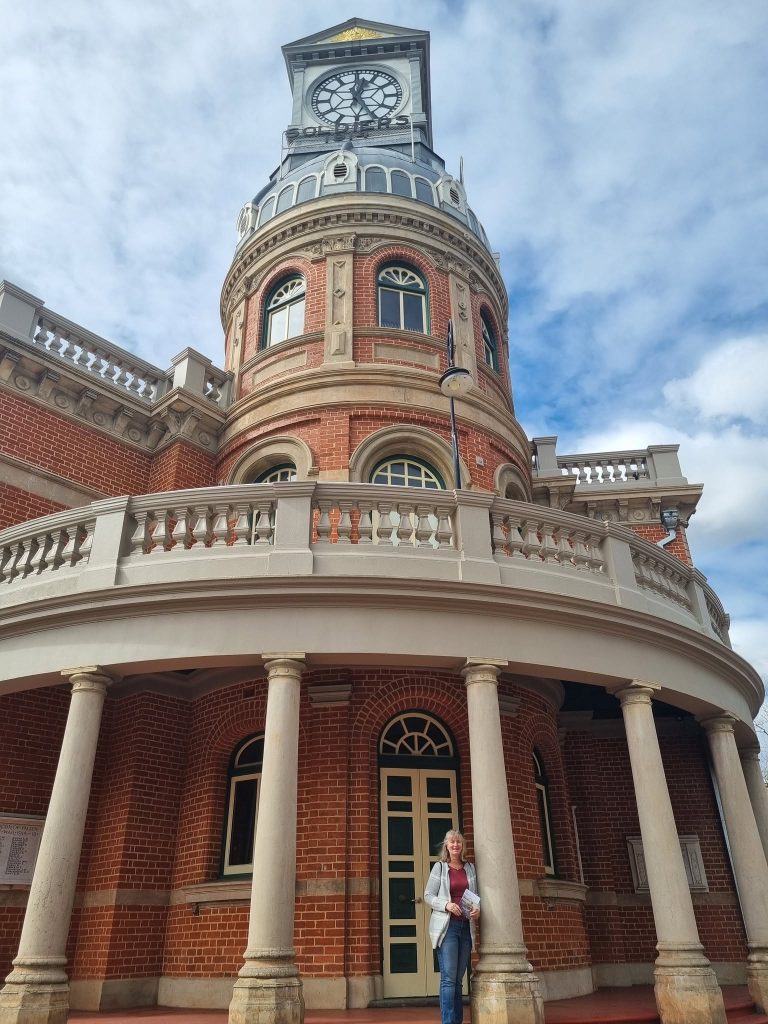
I kicked off Family History Month with a fascinating tour of the Midland Town Hall in Western Australia.
Having recently won an award for an article I wrote about a Federation-era cottage, I was interested to see another building from that era that was built for different purposes. Buildings are important as they are a result of people — people who planned them, built them, worked in them, adapted them, and remembered them that truly bring history to life.
The tour covered more than a century of history. The building was correctly described as being like the “Tardis.” We learned about the original first stage of the building in the early 1900s, the addition of the Soldiers Memorial Clock in 1923, and then the later additions. Various architecture from the stained glass windows to crafted staircases were preserved. There were stories of old councillors, local servicemen, a near-demolition, and even a murder on the stairs! An interesting fact shared during the tour was that “the four-sided clock mounted on top of a dome” is believed to be unique in Western Australia.
If local history interests you, the Midland Town Hall tour runs once a month, hosted by the wonderful volunteers at Midland and Districts Historical Society Inc.. It’s free — you can book through Humanitix.
Behind the Records: The Biographical Database of Australia Webinar
The second event was a webinar on the Biographical Database of Australia (BDA) — an online database of transcripts, indexes, and published biographies of deceased individuals who were born in, or arrived in, Australia.
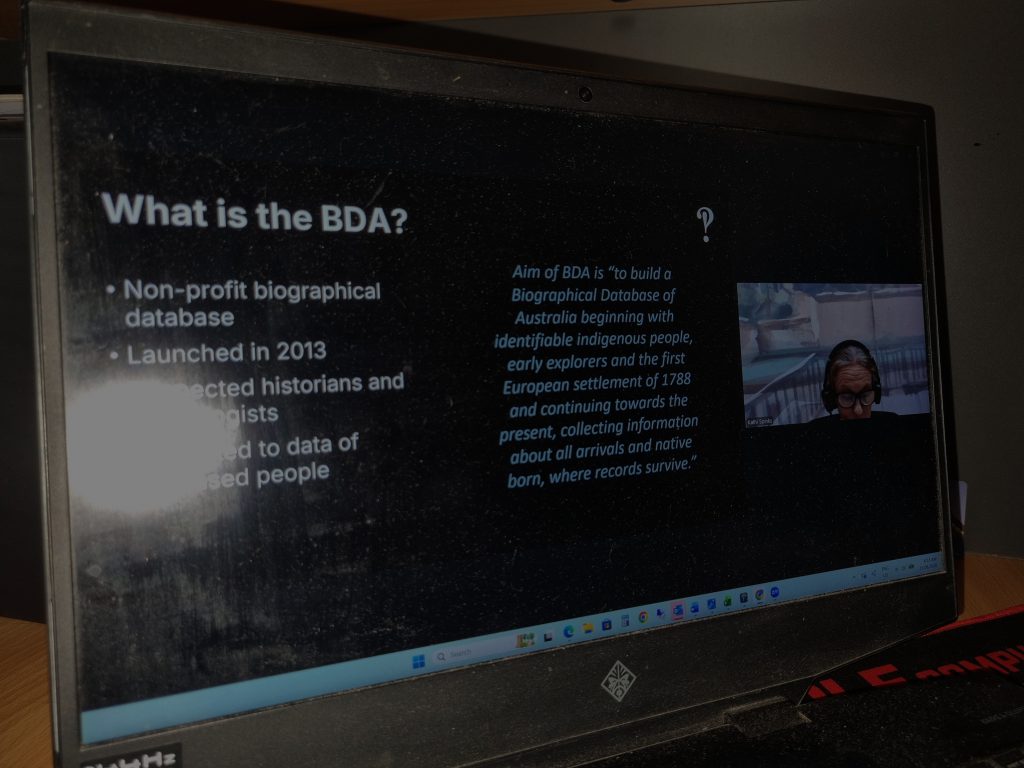
The webinar focused on how to actually use the database: what the various symbols mean, and how each index entry points you back to the details that matter for real research — the information contained in the record, the date of the record, and, crucially, the original source, so you can go and find that source again for yourself.
A couple of features stood out. Records for the same person are linked together, and, unlike some databases, those links are checked before they’re made, which cuts down on the kind of linking errors that can send your research down the wrong path. That said, you should still verify links yourself rather than take them on faith. Some records also include a link showing who else appears on that same record, which can be a handy way to spot family members, witnesses, or associates you might not have thought to look for.
It’s a good reminder that even with an index doing some of the heavy lifting, good genealogy still comes back to the original source — the BDA is a wonderful database of indexed records, not a substitute for the record itself.
Places and Records, Together
As genealogists, we often research people through records, but walking through the places where history happened adds another dimension to the stories we uncover. This August gave me a bit of both: a building that still holds the fingerprints of the people who shaped it, and a database built to make sure the paper trail those people left behind doesn’t get lost — or misattributed — along the way.
#NationalFamilyHistoryMonth #WAFamilyHistory #FamilyHistoryResearch